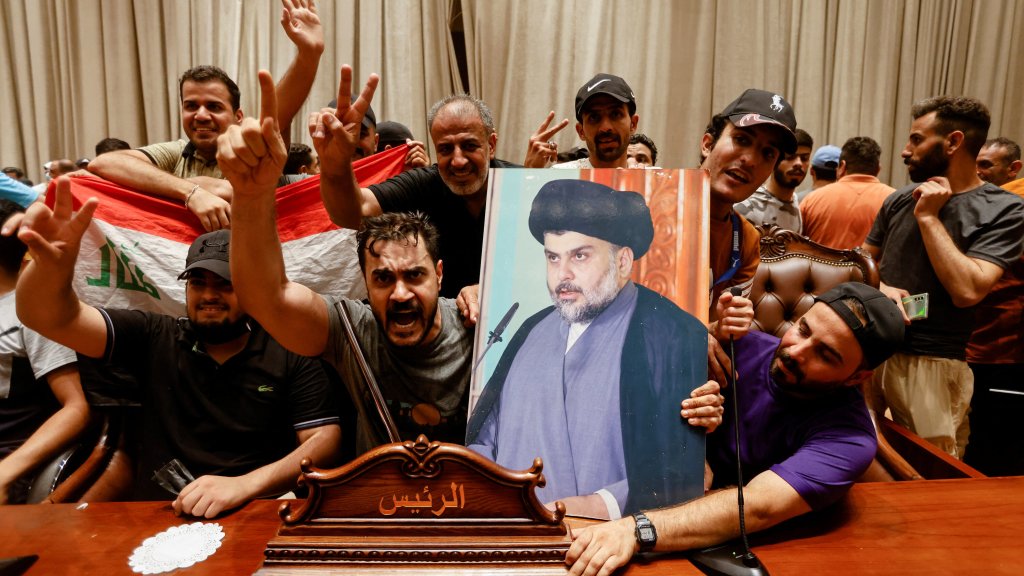
The Green Zone, Baghdad.
On Wednesday 27th of July 2022, hundreds of Iraqis stormed Baghdad’s heavily fortified green zone. These protesters, supporters of Shi’a cleric Muqtada Al-Sadr, mobilised and stormed the centre of Iraqi political power to voice their rejection of the proposed Prime Minister candidate fielded by the pro-Iran Coordination Framework, Mohammed Al-Sudani. Just days later, on Saturday 30th of July, they breached parliament again.
The protesters also voiced their opposition to the former Iraqi Prime minister Nouri Al-Maliki, whose term in office was marked by a brand of sectarianism some analysts attribute to the Sunni disillusionment which contributed to the rise of the Islamic State. Photos emerged of Al-Maliki walking the streets of Baghdad holding a rifle surrounded by guards from Iranian-backed elements of Al-Hashd Al-Sha’bi, Iraq’s state-incorporated militias who after defeating ISIS, act as a powerful political player.
Sadr’s Exit from Parliament
After winning the highest number of seats in the 2021 Iraqi general election after a campaign built upon anti-corruption and a nationalism that demanded the end of both American and Iranian influence in Iraq, Sadr and his supporters hoped to rid Iraq of foreign intervention and sectarianism through forming a government. Despite the initial electoral success, unwillingness to compromise and build a coalition between Sadr and his pro-Iran rivals caused a political stalemate referred to as the 2022 Iraqi Political Crisis.
Sadr, growing frustrated with the lack of progress in forming a government, and perhaps sensing political opportunity, resigned from parliament on 15th June 2022 and ordered members of his party to do likewise. This effectively gifted enough seats to the pro-Iran Coordination Framework, giving them the ability to nominate a new Prime Minister and control the government.
Whilst this appears to be a concession of defeat, it was widely speculated that Sadr withdrew his party for tactical reasons. If he can not bring the changes to Iraq that he campaigned on within the confines of the Iraqi parliament, perhaps he could do so from outside the established political processes with his large grassroots support through direct action. Another theory was that Sadr would let the pro-Iran coalition take the reigns of governance and watch them fall from afar. It seems the former approach of direct action, is the chosen method, at least for now. On Friday 15th July, hundreds of thousands of Sadr supporters rallied for a public prayer in the streets of Baghdad, a move which was seen as a flex of political might by the popular Shi’a clergyman. This, and the events of both Wednesday and Saturday, show the Iranian-backed elements active in Iraqi politics that many do not want an Iraq controlled by, or with closer than necessary ties to the Iranian regime.
The First Storming of Parliament
Supporters of Sadr, reportedly from around the country, gathered and mobilised themselves on Wednesday 27th of July, first in Tahrir Square in the morning before moving to the Green Zone where they attempted to, and succeeded in traversing and breaking down the high-security barriers that surround the district. In response, they were met by water cannons and clashed with riot police but ultimately gained entry to the parliament building, wherein the protesters sat and chanted anti-Iranian messages. In the evening, Muqtada Al-Sadr tweeted that “the message of the protesters has been heard and that they may now return to their homes”. They then were escorted out of parliament by elements of the Iraqi security forces.
The Second Breach
Analysts had warned that this would not be an isolated incident, and on the 30th of July, more Sadrists mobilised yet again and breached the Zaytoun Street, western side of the Green Zone. Iraqi Parliament was due to meet on this day to elect a new president and to name Al-Sudani as Prime Minister, but due to the protesters’ actions which caused a suspension of parliament, no voting could take place. The Iraqi Health Ministry released a statement saying that at least 100 protesters and 25 security personnel had been injured.
A Summer of Protests
In the 49℃ summer blaze of Baghdad, protests will continue until any solution is found between the pro-Iranian and Iraqi nationalist trends in Iraqi Shi’a political thought. In the 2019 protests, Iraqi security forces opened fire upon demonstrators, and many fear that history may repeat itself. The Shi’a of Iraq mourn the death of Imam Hussein on the 9th of August, and whilst some unity will be found between both factions as they unite to mourn the death of their beloved Hussein, tension will continue to boil as no progress is made.



 The Partisan report