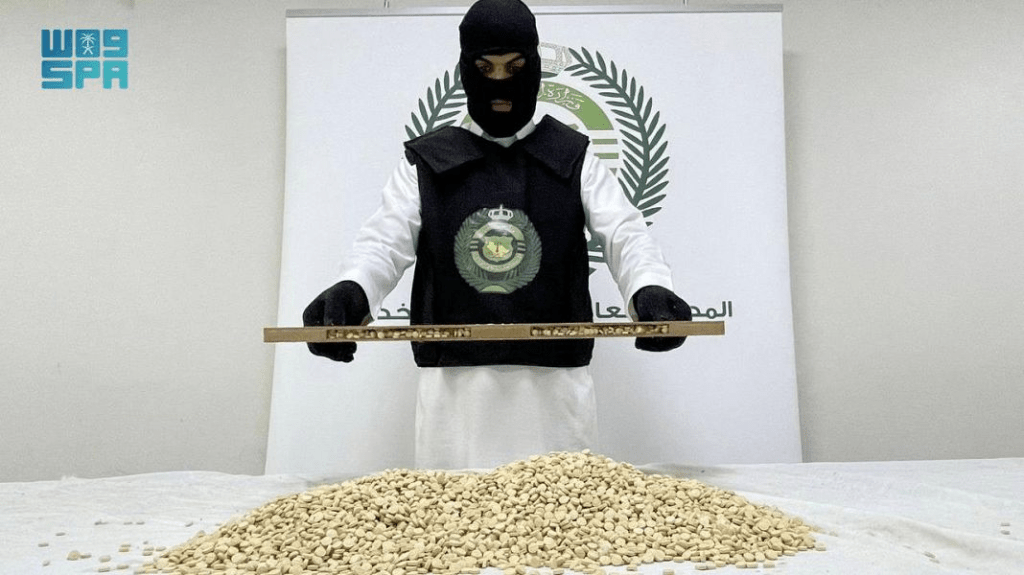
The Syrian civil war has been ongoing for over a decade, and amidst the chaos, the country has become a major player in the global trade of the drug Captagon. Captagon, the brand name for the drug Fenethylline, is a synthetic stimulant that has swept across the Middle East in recent years. According to an investigation by Agence France-Presse (AFP), the captagon trade in Syria is valued at billions of dollars, and has become one of the main sources of income for both criminal organizations and the Syrian government.

Indeed, the collusion between the Syrian government and criminal enterprises is a poorly kept secret. While the Syrian President Bashar al-Assad has denied any government involvement in narco-trafficking, figures close to the presidency have been implicated in the illicit trade.
Here, Lebanon’s ‘King of Hashish’ Nouh al-Zaiter (second from left) can be seen sitting next to a cousin of Bashar al-Assad, Wassim al-Assad, after the latter posted a photo of them meeting on his public Facebook page in Damascus’ Sheraton Hotel. Of additional note here, is the presence of Muhammad Zaroor, a security officer in Syria’s elite 4th Division. The 4th Division is based in the Latakia region, where Captagon is believed to be shipped to ports throughout the Middle East. Heading the 4th Division is none other than Bashar al-Assad’s brother, Maher.
Captagon: A very Syrian trade
The trade of Captagon in Syria is valued at billions of dollars, with some estimates claiming that it is worth at least three times the beleaguered Syrian national budget. The drug is produced from cheap and easily acquired ingredients in underground labs within the country and in nearby Lebanon, where Assad’s allies Hezbollah control the lawless borderlands of the Bekaa valley. Syria is believed to be home to 80% of global Captagon production.
From there, the drug is smuggled out through various routes, including through Jordan to major consumers in Saudi Arabia and by sea, primarily to Gulf countries but also to Europe in small quantities. Despite ongoing conflict and political instability, the Captagon trade continues to flourish in Syria.
Health Effects
In addition to the economic impact, the widespread use of Captagon in Syria has had a significant effect on the population. The drug is highly addictive, and its use has led to a rise in crime and social problems. While the cheapest, and lowest quality Captagon sells for as little as one dollar, premium quality Captagon can sell for as much as 25 dollars per pill. Additionally, due to its stimulant effects, the drug has also been linked to extremist groups, as it allows fighters to stay alert and focused during combat.
The use of Captagon has also had a devastating impact on the health of those who use it. The drug can cause a wide range of negative side effects, including anxiety, depression, and hallucinations. Long-term use can lead to serious health problems, including heart and lung damage, and can even be fatal.



 The Partisan report
Leave a comment