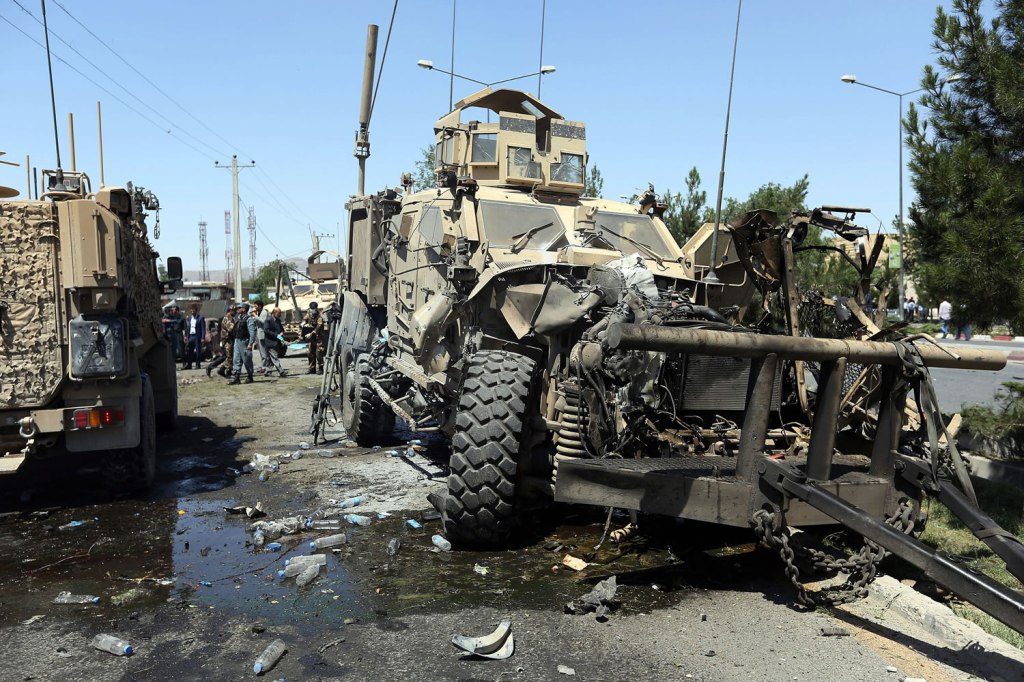
This year, an obscure militia group in Iraq has been claiming a series of attacks on what they describe as American convoys across the country. The name of the group that claimed responsibility is Faseel Al-Muqawama Al-Duwaliya, or the International Resistance Faction. This is not a real group. Analysts believe that it is a front set up by Harakat Hezbollah al-Nujaba, a component militia of the Popular Mobilisation Forces that enjoys an exceptionally close relationship with both Lebanese Hezbollah and Iran.
The organisation claimed the attack on their Telegram group at 01:04 local time on January 26 2023, 14 minutes after the attack took place.
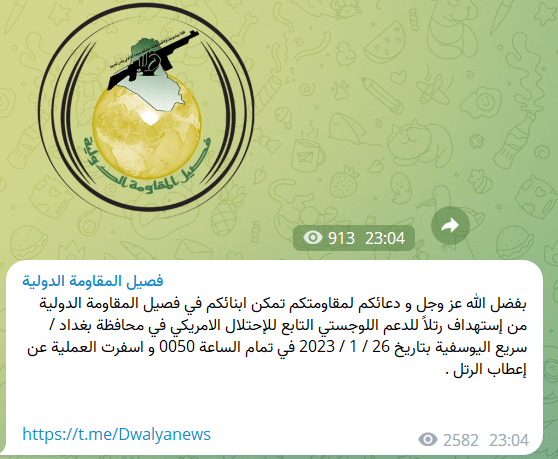
“Thanks to Allah Almighty and to your prayers for your resistance, your children in the international resistance faction were able to target the logistical support for the American occupation in Baghdad province / Saree Al-Yousafia on 01/26/2023 at 0050 hours and the convoy was delayed due to the damage of the attack.“
The same group claimed another attack exactly a week prior on January 19, and also the week prior on January 12, where yet another convoy was targeted in the greater Baghdad region.

Jihad Brothers Team, which is a Harakat Hezbollah al-Nujaba (HHN) media facade, was the first to report on the January 26 attack at 00:56, just six minutes after the attack took place. Unit10000, the Kata’ib Hezbollah facade equivalent of Jihad Brother’s Team, posted their own report seconds later. From this point onwards, Telegram and Twitter bots initiated the crucial process of spreading these messages on social media platforms, so that people could spread these claims even further afield. Eventually, information about the attack would reach national news agencies.
At a Glance: The International Resistance
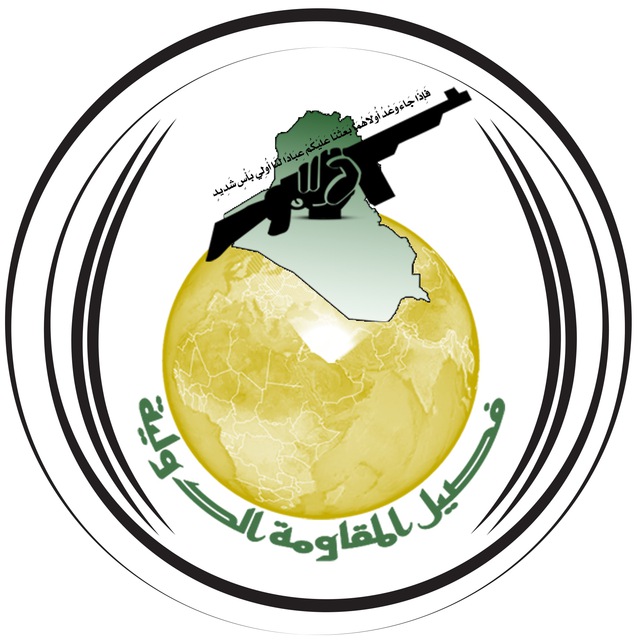
Faseel Al-Muqawamat al-Duwaliya, or the International Resistance Faction, claims to be a legitimate resistance faction operating in Iraq. The bio of their official telegram channel reads:
A channel dedicated to the most important news and operations of the Islamic Resistance, the International Resistance Faction.
Their logo depicts a yellow-shaded picture of an Iraq-centred earth, below which is the name of the group in Arabic. Iraq appears to be elevated above the earth, and through the centre of the country, a black hand holding a black rifle emerges, pointing upwards. This feature is common among the vast majority of Iranian-funded groups. On top of the rifle, the following Quranic verse is written (Surah 17 Al-Isra, Ayat 5-5).
“فَإِذَا جَآءَ وَعْدُ أُولَىٰهُمَا بَعَثْنَا عَلَيْكُمْ عِبَادًۭا لَّنَآ أُو۟لِى بَأْسٍۢ شَدِيدٍۢ”
“So, when the occasion for the first of the transgressions arrived, We raised against you some of Our creatures who were full of might.”
Interestingly, this Quranic verse describes a time where the ancient Israelites were destroyed by the Babylonians and Assyrians, two major Mesopotamia-native ethnic groups from ancient times. It can be inferred that the International Resistance Faction use this to build a Quranic narrative equating them with the mighty creatures of Allah who destroyed the ancient Israelites, who could be identified with the modern state of Israel.
Despite the official logo, telegram channel, and the claiming of multiple attacks as their own, The International Resistance Faction is not a real organisation. The International Resistance Faction, like so many other groups in Iraq, is a facade group, a front for Iranian-sponsored militias in Iraq to conduct kinetic paramilitary and military operations on US coalition forces and infrastructure in Iraq.
It is difficult to decipher who exactly is behind the International Resistance Faction. The Iranian Revolutionary Guard Corps (IRGC) certainly is, as they approve all militia operations in Iraq, but those Iraqis who actually organise and conduct the attacks likely belong to one of the many larger, ‘official’, Iranian-backed ‘resistance’ militias active within Iraq’s Popular Mobilisation Forces such as Kata’ib Hezbollah (KH), Harakat Hezbollah al-Nujaba (HHN), Asa’ib Ahl al-Haq (AAH), and others. In the case of the International Resistance Faction, there is a case to be made linking the group with either KH or HHN based upon the social media activity of overtly pro-HHN and -KH accounts when the International Resistance Faction claims an attack, with these accounts often re-posting and sharing the said attack. The difficult-to-follow trail from the International Resistance Fanction to HHN or KH is exactly why this method is employed by the Iran-alligned militias in Iraq.
Hybrid Warfare
Hybrid warfare is a sophisticated form of military strategy where a combination of traditional warfare tactics, such as the deployment and kinetic actions of ground troops, and unconventional methods, such as cyberattacks and disinformation campaigns are employed to achieve a strategic objective.
A crucial element of hybrid warfare is the involvement of non-state actors, such as militias or terrorist groups. These groups are often supported or directed by a state, but operate independently and are not officially recognised as regular armed forces. This allows the state to deny any involvement and maintain plausible deniability.
In hybrid warfare, disinformation and propaganda are also employed as a means of information operations to influence public opinion and create confusion among the enemy. This can be used to undermine the enemy’s morale and create division among the population, making it more difficult for the enemy to effectively respond to the attack. Furthermore, cyberattacks are used to disrupt critical infrastructure or steal sensitive information. This type of warfare is often difficult to detect and respond to, making it a potent tool for achieving strategic objectives.
In the case of Iraq, hybrid warfare is the main strategy of Iran through its Shi’a-led militias, who use a sophisticated disinformation and propaganda machine in combination with traditional kinetic military and paramilitary operations, such as convoy bombings, drone attacks, and rocket attacks. The hybrid nature of the Iran-backed militias’ approach can be directly observed in the multiple convoy bombings that occurred this month. The attack, at least reportedly, happens, and then news, often exaggerated, spreads around quickly on social media channels/accounts with tens of thousands of subscribers/followers/members.
Disinformation as a Weapon of the Militias
These self styled ‘resistance’ factions in Iraq claim attacks targeting these supposed convoys, but just how legitimate are these attacks? Do they actually occur? And what of these convoys? Does the United States really allow its convoys to be attacked by Iranian-backed militias without retaliation?
These attacks are incredibly difficult to verify due to a number of factors, notably a poor in-country reporting framework. News organisations and media sites often don’t report on these attacks, and on social media, bots and Iranian-affiliated accounts seem to be the only ones relaying and sharing information on the said attacks, much of which is a copy-paste message from the original source on Telegram. Some self-styled counter-terrorism organisations and databases do report on these attacks, but they too use the same sources that the Iranian-aligned movements use to share their messages, rendering their information unreliable. What is certain, is that some of these attacks do occur, despite how difficult it can be to establish which ones do using open-source research methods. Questions remain however on what these supposed militias are targeting.
In practically all of the Telegram messages claiming responsibility and spreading (dis)information on these attacks, the target of these IED attacks is worded the same:
Logistical support for the American occupation.
With such broad terminology, this could mean anything. What it almost always means is an Iraqi-operated truck or truck company with a sometimes obscure connection to one of the American bases in Iraq, such as Ain al-Asad. The attacks will sometimes target a truck delivering food to one of the bases operated by American forces; sometimes the attack will target a truck belonging to a company which has previously or is currently delivered goods to one of the American bases; and sometimes the attacks will target a truck-delivery company behind in bribe payments to one of the militias attempting to establish a mafia-rule over Iraq.
Hence, these attacks are not legitimate, they do not target the US military as many would believe. Instead, they are part of a wider disinformation and hybrid warfare campaign aimed at convincing regular Iraqis that these ‘resistance’ militias are actively fighting the American occupation in Iraq. These attacks rarely cause significant damage to the truck, let alone inflict casualties. They are by all means, fake attacks.



 The Partisan report
Leave a comment