
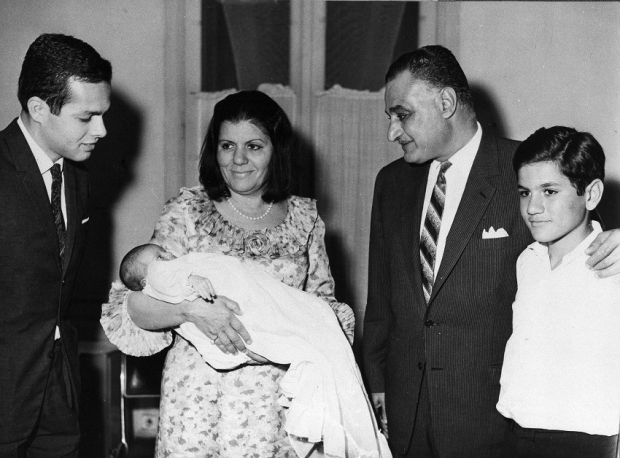
On the afternoon of June 27th, 2007, in broad day-light, a man was found dead outside of his residence at 24 Carlton Terrace, in central London.
He was lying face down, five stories below his apartment, with no conclusive evidence of whether his fall was voluntary, or he had been pushed off…
But what was so special about this man?
The answer lies in the question: How can someone be a national hero in both Egypt and Israel?
That much can be said of Ashraf Marwan.

The Making of Marwan
Born in Egypt, to a prominent army general, Marwan would later pursue chemistry at Cairo University. There, he meets the daughter of Egyptian President, and Arab darling, Gamal Abdel Nasser. Before long, they marry, and, following Nasser’s passing in 1970, Marwan remains within the circle of politics and rises to become the right-hand man to the new President, Anwar Sadat.
At the time, Egypt’s leadership was concerned with the liberation of lands lost to Israel in the six-day war of 1967, namely the Sinai Peninsula. Sadat and Marwan, together, worked to prepare their army for a renewed conflict that would see them restore Egypt’s full territorial integrity.
Importantly, the plans for the war were being made in utmost secrecy, with only a handful in the highest echelons of power being aware of the intentions of Egypt’s mobilization. These plans were being done in tandem with the Syrians, who were preparing for their own offensive into the occupied Golan Heights.
It is in the midst of these deceptive manoeuvres that Marwan approaches the Israelis in London. Naturally, the Israelis are stunned; the son-in-law of the Champion of Arabism is a turncoat? Over time, Marwan feeds the Israelis some of the most top-secret intelligence available to him, including minutes of secret meetings with the Soviets, the Egyptian Army’s order of battle, and much more.
Why?
Interestingly, Egypt and Israel both agree on the fact that Marwan had, indeed, leaked vital intelligence to Israel. Rather than be seen as a traitor, the Egyptian people and government still regard Marwan as a hero.
Perhaps equally important is to understand why he leaked intelligence in the first place. Understanding Marwan’s motives would illuminate one of the most important unsolved mysteries in modern Middle Eastern history. Answering this question could potentially imply who the real winner of 1973 was.
So, what are the facts?
Israeli Narrative
On the eve of the 50th anniversary of the 1973 (Yom-Kippur) conflict, the state of Israel conveniently declassified a myriad of documents relating to the anticipation of conflict leading up to October 6th, as well as its actual unfolding and aftermath. Importantly, these documents were never disclosed to the Agranat Commissions, which was a special inquiry launched to investigate the IDF’s failure to predict or foresee the surprise attack by Egypt and Syria.
These documents do not include the exact documents Marwan had shared with the Israelis, however, they do reference his general intelligence assessments.
October 5th, 1973. A telegram from then Director of Mossad, Zvi Zamir, to then Prime Minister Golda Meir.

In this telegram, Zamir details to Meir the various unfoldings taking place immediately before the war, with the actual outbreak of conflict being anticipated. It describes Sadat’s selection of 6th October as the date of the war, the convening of the Egyptian Supreme War Council, coordination with the Syrians, and much more.
Interestingly, the telegram makes consistent references to an individual known only as ‘the source’. Of course, this is Marwan, but what exactly is the significance of Marwan’s intelligence to the Israelis?
Marwan mentions a handful of points:
1) He does not doubt that the Syrians will follow through with the war, alongside the Egyptians. However, he does doubt the timing of their assault.
2) He believes the probability of the attack taking place is 99%, with 1% left to the possibility of President Sadat changing his mind at the last minute.
3) He is adamant that certain preparations and manoeuvres are not a “political trick” but a genuine intention to war.
4) He believes publicizing knowledge of the war through newspapers, radios etc. may discourage the Egyptians under the impression that the Israelis are aware and prepared for conflict.
Interestingly, Zamir is in agreement with the last point and urges Meir to publish knowledge of the [preparations for] war to the public. Assuming that the Israelis trusted Marwan and his judgement then this action would have been taken. So, what did the newspapers of Israel say on 5th October 1973, just one day before the surprise attack?
Ma’ariv, ‘Al-ha Mishmar (or Al HaMishmar), and Davar were the most active Hebrew-language newspapers in Israel at the time. Using the National Library of Israel, a review of their front pages on October 5th shows no mention Egypt or Syria or a possible conflict. Instead, they are all preoccupied with the Marchegg kidnappings by Palestinian militant group As-Sa’iqa. Indeed, Meir had considered the kidnapping so serious that she personally went to Vienna some days after the kidnappings to negotiate with the Austrians. This is an issue that would later come up in the Agranat Commission, concluding that Meir’s preoccupation with the Marchegg affair left her unready to address the Arab surprise attack.
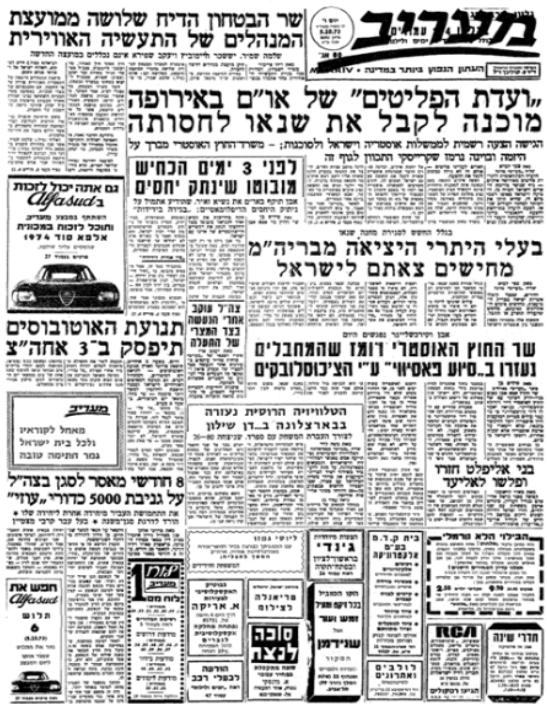
Front page of Israeli newspaper Ma’ariv, October 5th 1973.

Front page of Israeli newspaper ‘Al-ha Mishmar, October 5th 1973.
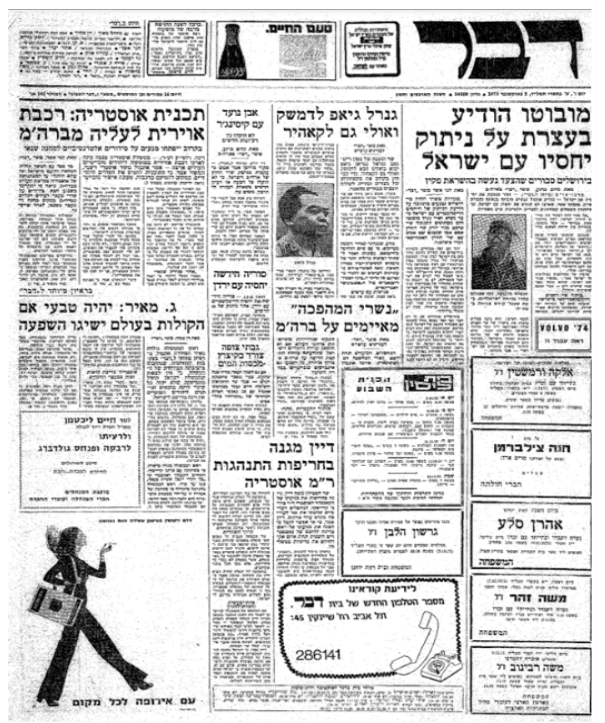
Front page of Israeli newspaper Davar, October 5th 1973.
Ultimately, Marwan had warned of possible military confrontation, even claiming it was “99%” likely, however, the atmosphere in Israel, even 24 hours before the war, does not reflect this at all. How can this be explained? It is possible that the Israeli leadership did not want to issue a possible false warning on such an important and sacrosanct day, as Yom Kippur. However, alternative assessments could be true. Either the Israelis were not totally convinced of Marwan’s intelligence or they were convinced of it but did not know how to react.
To understand this, the newly-declassified documents must be revisited.
December 1st, 1972. Israeli leadership meeting in Golda Meir’s bureau
Some 10 months before the war, Golda Meir convened a meeting between all heads of the military and intelligence branches. The most notable attendees were the head of Mossad, Zvi Zamir; head of military intelligence, Eli Zeira; Chief of General Staff David Elazar; and Minister of Defence, Moshe Dayan. Intriguingly, all of them agreed on the intelligence assessment that Egypt could but was unlikely to renew large-scale fighting in the Suez. They also agreed that if any conflict were to take place it would be limited and the Israeli response would be swift and strong enough to end the war as swiftly as had been done in 1967.
How did the Israeli command go from low probability of conflict to being caught off-guard on 6th October 1973?
The answer lies in the fact that this was not the first time Marwan had warned of conflict. Some months earlier, between April and May, Marwan had already delivered several serious warnings of an outbreak of conflict. Although the Israeli leadership took these warnings seriously, they – somewhat inexplicably – failed to react. The most significant reaction involved raising the IDF military alertness level to its highest; “blue and white”. However, this lasted – conveniently for the Arabs – only until the end of August. One of the reasons the Israeli leadership underestimated the threat of conflict was due to the belief that these threats were deliberate calculations by the Arab side intended to pressure the superpowers of the US and USSR to force a political solution on the region that Israel would have no choice but to acquiesce to.
Ultimately, the Israel leadership maintained that the genuine threat of all-out war was close to zero.
Egyptian Narrative
It is clear that Marwan collaborated with the Israelis by providing a mass of intelligence. However, many argue that his intelligence was meant to mislead the Israelis under the direction of Sadat himself.
Unfortunately, there is no official Egyptian narrative regarding Marwan’s role leading up to, and during, the 1973 war. Nevertheless, there are hints as to the significance of his role.
First of all, after the war, Sadat awarded Marwan with several honours and medals, among which is the highest award an Egyptian can receive – likely the Order of the Nile. It is clear that Marwan was well rewarded and regarded following the war, which would be surprising since the Egyptians are unofficially aware of his collusion with the Israelis.
In addition to Sadat’s recognition of Marwan’s role, succeeding President Hosni Mubarak – who was head of the Air Force during the 1973 war – had this to say following Marwan’s mysterious death:
He [Marwan] carried out patriotic acts which it is not yet time to reveal. But he was indeed a patriotic Egyptian, and not a spy for any organisation at all…
Figure 5, Screenshot from YouTube Documentary Who Murdered the World’s Greatest Spy? Depicting Marwan [right] shaking hands with Hosni Mubarak [left] soon-to-be President of Egypt with current President Anwar Sadat [middle] present. This photo is taken after the war and is presumably during the awarding ceremony where Marwan received his medals for his role in the war.

Mysteriously, one of the last and most important revelations regarding Marwan’s role in the conflict comes from his own wife, daughter of Gamal Abdel Nasser, Mona. In an interview with Egyptian television outlet Ikhtiraq, Mona is asked about Marwan’s role with the interviewer stating “If he was in contact with the Israelis, it was under Egyptian orders?” Mona answers:
This is not even to be questioned; I am not going to defend something [that] I do not need to. This is something I am sure of 100%, not even just 100%…
Everyone fights in their own way…
Never a loose end… Or is there?
Among the plethora of evidence and ‘pseudo-evidence’ there is that speak to both possibilities of Marwan’s role as a spy for Israel or double-agent for Egypt, there is one interesting fact that ought to be mentioned.
Marwan’s manner of death is not the only one of its kind. In fact, three other Egyptian nationals had met the exact same fate. Soad Hosny, the so-called ‘Cinderella’ of Egypt for her role in Egyptian cinema, similarly fell to her death in Westminster, London, in 2001. In the mid-70s, the Egyptian Ambassador to Britain had the same ‘ending’, also in London, as did Ali Shafik, secretary to former Egyptian Vice-President, Abdel Hakim Amer, in 1977, in London.
Marwan makes the fourth Egyptian national to die from falling off a balcony in London. If ‘once is an accident, twice is a coincidence, but three times is a pattern’ then what about four times?…
Closing The Story
One cannot say with complete confidence where Marwan’s true loyalties lay…
It remains the case that he is considered a national hero for both the nations of Israel and Egypt who were at one point sworn enemies.
Although Marwan fed the Israelis copious amounts of intelligence that undoubtedly helped them and put them in a position where they were not ‘walking in the dark’, so to speak. However, this intelligence amounted to little in the end, considering the Israelis were nonetheless caught by surprise.
Whether a deliberate act of deception or otherwise, the result was all the same; Israel had been lulled into a false sense of security under the pretence that the Arabs were unlikely to attack and, if they did, the IDF would push them back with ease.
Is this a result of Marwan’s foxiness or Israeli hubris? The Agranat Commission would conclude the latter. Alas, the Commission was not privy to the documents recently declassified, and likely, this meant that they were probably not privy to the existence of this ‘super spy’. It is, therefore, not far-fetched to suggest the Commission reached an incorrect, or inaccurate, conclusion.
Indeed, the Head of Mossad had already concluded years after the Commission that the intelligence failure was not internal, but a result of deception from Marwan. In other words, Eli Zeira had come out and claimed that the entire Israeli intelligence and military had been duped by one man.
However, Zeira was one of many who were essentially forced to resign following the conclusions of the Agranat Commission. Along with the Prime Minister, Meir, and Minister of Defence, Dayan, and others, Zeira stepped down and moved to the US. It is possible that his assessment of Marwan being a double-agent was a manoeuvre to shrug off responsibility; to identify a scapegoat and make himself innocent.
It is worthwhile to remember that Egypt had fulfilled all of its political needs following the war, most importantly among them was the recapture of the Sinai Peninsula and a secure border with Israel. Whilst the Israeli leadership reeled from the humiliation, Egypt had revived its reputation and dignity by recapturing Sinai and securing peace with Israel. Although the peace was seen as tantamount to betrayal to the rest of the Arab world, the shocking defeat of 1967 was perhaps too much for Egypt and it knew that it had to reach specific political goals.
According to historian Ahron Bregman – who is largely considered to be the one who ‘unmasked’ Marwan as the double-agent – he met with Marwan himself in London barely months before Marwan’s death. According to Bregman, the conversation drifted towards the topic of the conflict, at which point Bregman asked “Why did you say sunset when the war started at 2pm?”
Here Bregman is referring to Marwan’s claim that the war he had warned Zamir of on the eve of 6th October, would begin in the evening of October 6th. In reality, the war started virtually at midday. Was this a mistake by Marwan or another ruse to confuse the Israelis once and for all? Marwan’s reply speaks volumes, and at the same time says nothing; in true diplomatic, dare one say ‘spy fashion’…
What are a few hours between us?



 The Partisan report
Leave a comment