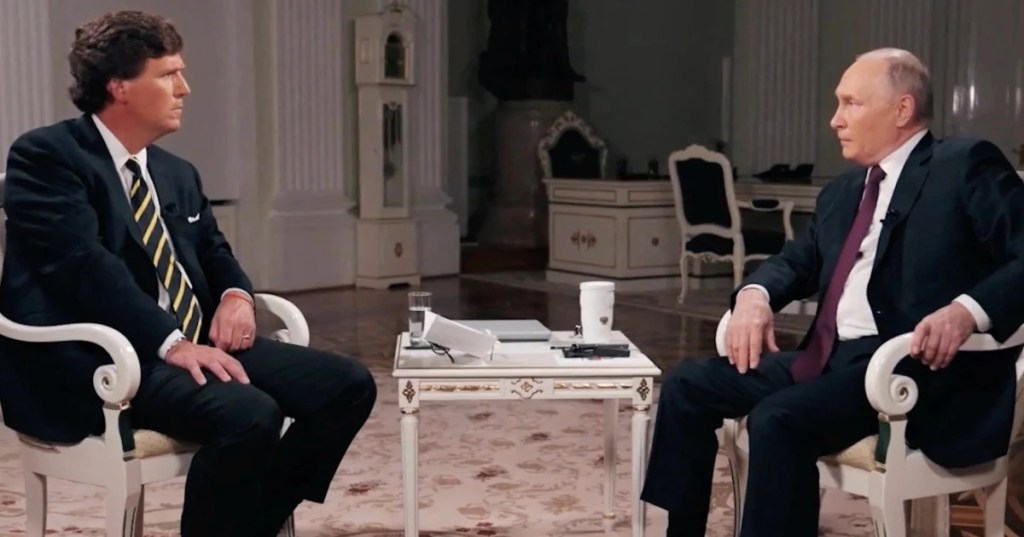
Ahead of the two-year anniversary of the Russian invasion of Ukraine, renegade journalist, Tucker Carlson, sat down with Russian President, Vladimir Putin, in the first interview granted to a Western journalist by the Kremlin since the beginning of the war.
The interview turned many heads. At times, sounding like a seasoned politician, and at other times an intelligence operative (which is unsurprising considering his KGB past), Putin easily weathered Carlson’s at-times timidly phrased questions which reflected cracks in the legacy of Containment rhetoric.
It was described by many as a mere ‘lecture of history’ by Putin towards Carlson. However, contextualising it with his infamous 2007 Munich Speech goes a long way in illuminating the current state of the global political order.
The Past
Despite the interview being much more than a simple ‘history lecture’ as many commentators have put it, the first twenty minutes indeed involves Putin digressing in pedantic historical detail regarding the history of Ukraine and Russia, effectively justifying his invasion which he has downplayed as a ‘special military operation’.
Putin suggests that the Ukrainians and Russians are one and the same people: Rus. He claims that the Ukrainian identity developed as a result of outside interference from various regional powers over the centuries who deliberately manipulated this identity in order to undermine Russia.
Importantly, he recounts the two world wars, describing how Austria encouraged the growth of Ukrainian nationalism in the early 20th century and the collaboration of the most extreme Ukrainian nationalists with Nazi Germany. Ultimately, Putin suggests that the Ukrainian identity has its roots in foreign conspiracy, reducing his invasion of Ukraine to nothing more than a historical correction or ‘denazification’.
In his interview with Tucker Carlson, it is clear that Putin’s view of history is that the past has been unjust to Russia’s detriment. When compared to his 2007 Munich Speech, Putin displays a similarly bitter reading of the political status quo.
The Present
In this speech, Putin begins by decrying the post-Cold War unipolar world order. He describes unipolarity as a “pernicious state of affairs” having “nothing in common with democracy”. Furthermore, he claims that rather than produce peace or stability, the unipolar order produces instability and insecurity, stating that it has given precedent to the “hyper use of force” which produced conflicts with much larger casualties.
Putin goes on: “I want to emphasize this – no one feels safe! Because no one can feel that international law is like a stone wall that can protect them”. Undoubtedly, Putin is motivated by the US invasion of Iraq and deposal of Saddam Hussein. For him, America’s role in the politics and conflicts of the rest of the world is a step too far: rather than bringing the rest of the world up, the hegemon is putting the rest of the world down.
Interestingly, Putin basically foresees the post-‘Arab Spring’ conflicts of the Middle East by arguing that the economic imbalance inherent of a unipolar world encourages the growth of radicalism and extremism in developing countries as they see how “unfair” the world is.
In sum, by Putin’s logic, the violence and conflict we have seen in the rest of the world in the 21st century are corrections: that the unipolar world order is so inherently unstable and unfeasible that it inevitably leads to conflicts aimed at restoring balance.
One begins to notice some consistency in Putin’s narrative – though perhaps dogma is a more accurate term. For Putin, the invasion of Ukraine is as justifiable as the invasion of Iraq is unjustifiable. While the former sets to reverse the consequences of the unipolar world order (after the collapse of the Soviet Union) the latter is the most abominable manifestation of that order; the violation of international law at the will – and indeed in the interest of – the hegemon.
The Future
One ought to be cautious when trying to make predictions for future politics. This is especially true considering the pace at which the world is changing.
In barely a single generation, the world saw the fall of the Berlin wall, the collapse of the Soviet Union, Fukuyama’s End of History, the invasion of Iraq, the so-called Arab Spring, ISIS, and now the invasion of Ukraine.
What does this all mean? The defining feature of the last two decades, since we entered the new millennium, has been the changing balance of power. This change has been so rapid that political analysts cannot keep up with many either jumping to conclusions and declaring that the multipolar world order is already here while others practice a certain stubbornness, declaring that the post-Cold War hegemony of the US still exists.
Putin’s 2007 speech shows his discontent with the unipolar order of the 1990s/2000s, but his 2024 interview with Tucker Carlson shows how he is working towards unmaking that order. We are not in a multipolar world but things are changing. The question is what that may look like. Unfortunately, the answer may not be reassuring. As Putin’s speech and interview show, the unipolar order – which is growing older by the day – is looked upon by weaker countries in contempt and disdain. Unipolarity and the post-Cold War world failed to answer the most pressing questions. Rather than ushering in an epoch of peace and stability, the world has not shaken off problems like poverty, terrorism, economic inequality and climate change.
Countries are hurrying to protect themselves and relying on complex webs of alliances to ensure their security. Arms races are the fashion once again and little negotiation is being done to reverse or even slow this. Putin himself admitted that he had not had any interaction – at least a non-confidential interaction – with Biden in over two years.
However, one important remark to make regarding this shift in the balance of power is that US power is not completely waning. Despite American diplomacy suffering from the presidencies of two men considered entirely unfit to govern by half of their people, the US Army is undoubtedly the dominant force in the world. Nevertheless, it seems that countries like Russia and China do not necessarily want to take America’s place, and thereby confront the US directly (because they cannot), but want to be at the winner’s table.
In a way, Putin wants to do what his adversaries have always been free to do: violate international law to their own benefit and not suffer any repercussions because they themselves are judge, jury, and executioner.
Ergo, unless US power is able to contain the growing influence of its enemies we could expect the future multipolar world order to adjust our current institutions, treaties and even borders, as it accommodates for a world with multiple centres of power.



 The Partisan report
Leave a comment